


You know the amazing programs and opportunities your school offers, but somehow it’s just not reaching the families you want to connect with. Frustrating, right?
Many schools face the same challenge: standing out in search results so prospective families can find and connect with them.
The good news is, you don’t need to overhaul your entire website to start seeing results. By focusing on on-page SEO, specifically by fine-tuning your page titles and descriptions (also known as title tags and meta descriptions), you can make your site more visible and appealing in search results.
In this article, we’ll walk you through how a few strategic updates can improve your rankings and help your school get noticed by the families you want to reach.
What is on-page SEO?
On-page SEO refers to the optimization techniques applied directly to your school website’s pages to improve its search engine rankings and attract more organic traffic. It focuses on optimizing various elements within the webpage itself to make it more relevant, authoritative, and user-friendly in the eyes of search engines.
Understanding Title Tags and Meta Descriptions
Title tags and meta descriptions are HTML elements that provide information about a webpage’s content. The title tag is displayed as the clickable headline in search results and the browser tab. The meta description is a brief summary of the page’s content shown under the title tag in search results.
Imagine you’re browsing the internet for private schools. What catches your eye first? It’s often the title tag—the clickable headline that appears in search results.
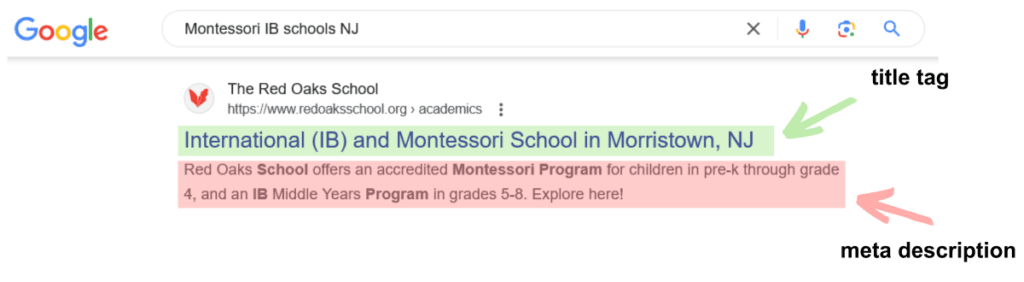
Once a parent sees your title tag, the next thing they’ll notice is the meta description—a brief summary of your page’s content.
Tips for crafting impactful Title Tags and Meta Descriptions
Your title tag is your website’s first impression: it should be clear, engaging, and relevant.
Here are some tips to make your title tags stand out:
- Be descriptive: Summarize the page content accurately. Parents should know what to expect when they click on your link.
- Include one target keyword: Place your main keyword in your title tag, closer to the start for better ranking. Make sure they flow naturally within the title.
- Make it unique: Each website page should have a unique title tag that matches the content, preventing confusion for readers and search engines.
- Keep it short: Keep title tags under 60 characters to avoid being cut off in search results.
Your meta description serves as a brief preview of your page’s content. It’s your chance to expand on the title and provide more reasons for parents to visit your website.
Here are some tips for creating engaging meta descriptions:
- Summarize clearly: Provide a concise overview of the page’s content.
- Include a Call-to-Action (CTA): Encourage parents to take the next step, whether learning more, visiting your school, or contacting you.
- Highlight benefits: Emphasize what makes your school special. Mention specific programs, values, or benefits that will attract parents’ interest.
- Make it unique: Just like with title tags, it’s crucial to craft distinct descriptions for every page on your website.
- Be concise: Aim for 150-160 characters (include spaces) to ensure the full description is visible in search results.
Remember, you can always update title tags and meta descriptions if they’re not generating traffic.
Where to update or add these elements on your website
Most content management systems (CMS), like WordPress, Finalsite, or Wix, make it easy to update your title tags and meta descriptions.
You can either edit the HTML directly or use the metadata settings built into the platform.
If you’re using WordPress, the free Yoast SEO plugin is a great option. It lets you update these fields right in the page settings, no coding required.
Pro-Tip
Use a free SERP simulator to see what users would see when they search for schools like yours. This simple tool helps you preview how your title tags and meta descriptions will appear in search results, allowing you to make adjustments before going live.
In conclusion
As search engines continue to evolve, one thing remains clear: optimizing your title tags and meta descriptions is still essential in 2025.
While the world of SEO changes, these simple yet powerful elements are key to attracting the right visitors, improving your search rankings, and connecting with prospective families.
By fine-tuning your title tags and meta descriptions, you’re not just helping your school rank higher; you’re making it easier for families to find exactly what they’re looking for when they search online.
Small tweaks in these areas can have a big impact, helping your school stand out in a crowded digital world and ensuring that your website speaks directly to those who matter most: potential students and their families. So, take the time to get these right. It’s a simple step that can lead to big results.